



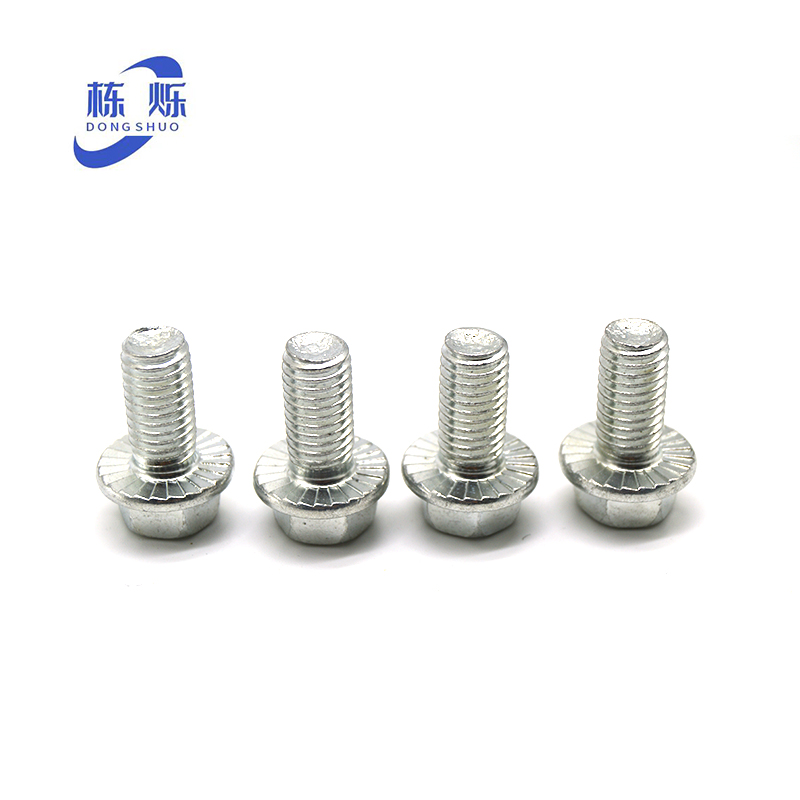


Galvanized DIN 6921 Flange Hexagon Bolts - High-Strength Fasteners from China Suppliers & Factory
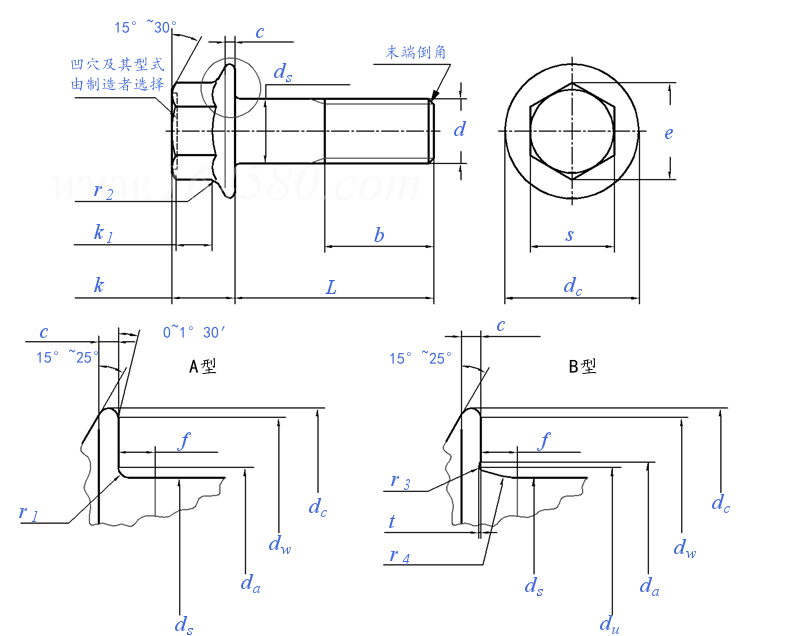
| Thread specifications d |
M5 | M6 | M8 | M10 | M12 | M14 | M16 | M20 | ||
| P | Pitch | Coarse teeth | 0.8 | 1 | 1.25 | 1.5 | 1.75 | 2 | 2 | 2.5 |
| Fine Teeth 1 | / | / | 1 | 1.25 | 1.5 | 1.5 | 1.5 | 1.5 | ||
| Fine Teeth 2 | / | / | / | 1 | 1.25 | / | / | / | ||
| b | L≤125 | 16 | 18 | 22 | 26 | 30 | 34 | 38 | 46 | |
| 125<L≤200 | / | / | 28 | 32 | 36 | 40 | 44 | 52 | ||
| L>200 | / | / | / | / | / | / | 57 | 65 | ||
| c | Min | 1 | 1.1 | 1.2 | 1.5 | 1.8 | 2.1 | 2.4 | 3 | |
| da | Type A | Max | 5.7 | 6.8 | 9.2 | 11.2 | 13.7 | 15.7 | 17.7 | 22.4 |
| Type B | Max | 6.2 | 7.4 | 10 | 12.6 | 15.2 | 17.7 | 20.7 | 25.7 | |
| dc | Max | 11.8 | 14.2 | 18 | 22.3 | 26.6 | 30.5 | 35 | 43 | |
| ds | Max | 5 | 6 | 8 | 10 | 12 | 14 | 16 | 20 | |
| Min | 4.82 | 5.82 | 7.78 | 9.78 | 11.73 | 13.73 | 15.73 | 19.67 | ||
| du | Max | 5.5 | 6.6 | 9 | 11 | 13.5 | 15.5 | 17.5 | 22 | |
| dw | Min | 9.8 | 12.2 | 15.8 | 19.6 | 23.8 | 27.6 | 31.9 | 39.9 | |
| e | Min | 8.71 | 10.95 | 14.26 | 16.5 | 17.62 | 19.86 | 23.15 | 29.87 | |
| f | Max | 1.4 | 2 | 2 | 2 | 3 | 3 | 3 | 4 | |
| k | Max | 5.4 | 6.6 | 8.1 | 9.2 | 11.5 | 12.8 | 14.4 | 17.1 | |
| k1 | Min | 2 | 2.5 | 3.2 | 3.6 | 4.6 | 5.1 | 5.8 | 6.8 | |
| r1 | Min | 0.25 | 0.4 | 0.4 | 0.4 | 0.6 | 0.6 | 0.6 | 0.8 | |
| r2 | Max | 0.3 | 0.4 | 0.5 | 0.6 | 0.7 | 0.9 | 1 | 1.2 | |
| r3 | Min | 0.1 | 0.15 | 0.2 | 0.25 | 0.3 | 0.35 | 0.4 | ||
| r4 | ≈ | 3 | 3.4 | 4.3 | 4.3 | 6.4 | 6.4 | 6.4 | 8.5 | |
| s | Max=Public | 8 | 10 | 13 | 15 | 16 | 18 | 21 | 27 | |
| Min | 7.78 | 9.78 | 12.73 | 14.73 | 15.73 | 17.73 | 20.67 | 26.67 | ||
| t | Max | 0.15 | 0.2 | 0.25 | 0.3 | 0.35 | 0.45 | 0.5 | 0.65 | |
| Min | 0.05 | 0.05 | 0.1 | 0.15 | 0.15 | 0.2 | 0.25 | 0.3 | ||
| Thread length b | - | - | - | - | - | - | - | - | ||
|
1, e Min. = 1.12 x S Min. 2, material: a) steel, strength class (material): 8.8,10.9,12.9, Din Iso 898-1 b) stainless steel, strength class (material): A2-70, DIN 267-11 |
||||||||||
The flange hexagonal bolt has a large tightening force, which can firmly connect the flange and the connected components, ensuring the stability of the connection.
It can not only transmit fastening force, but also transmit the power required by machines, equipment, etc.
The use of flange hexagonal bolts can isolate the connection from external media and ensure the sealing of the device.
Due to its "support area to stress area ratio" being greater than that of ordinary bolts, flange hexagonal bolts can withstand higher preload force and have better anti loosening performance.
A DIN 6921 flange hexagon bolt is a hex head clamping bolt featuring an integrated washer-like flange. This flange distributes the clamping load over a larger surface area, eliminating the need for a separate washer.
They are commonly manufactured in carbon steel with strength classes 8.8, 10.9, and 12.9 (according to DIN ISO 898-1), as well as stainless steel of strength class A2-70 (according to DIN 267-11).
Galvanization provides a protective zinc coating that significantly improves the bolt's resistance to corrosion, rust, and environmental wear, making them ideal for outdoor and industrial applications.
Type A and Type B refer to differing maximum underhead transition diameters (da). Type B typically allows for a slightly larger transition dimension compared to Type A, depending on specific application requirements.
The flange increases the overall support area relative to the stress area. This design allows the bolt to sustain higher preload forces and increases friction under the bolt head, reducing the likelihood of loosening due to vibrations.